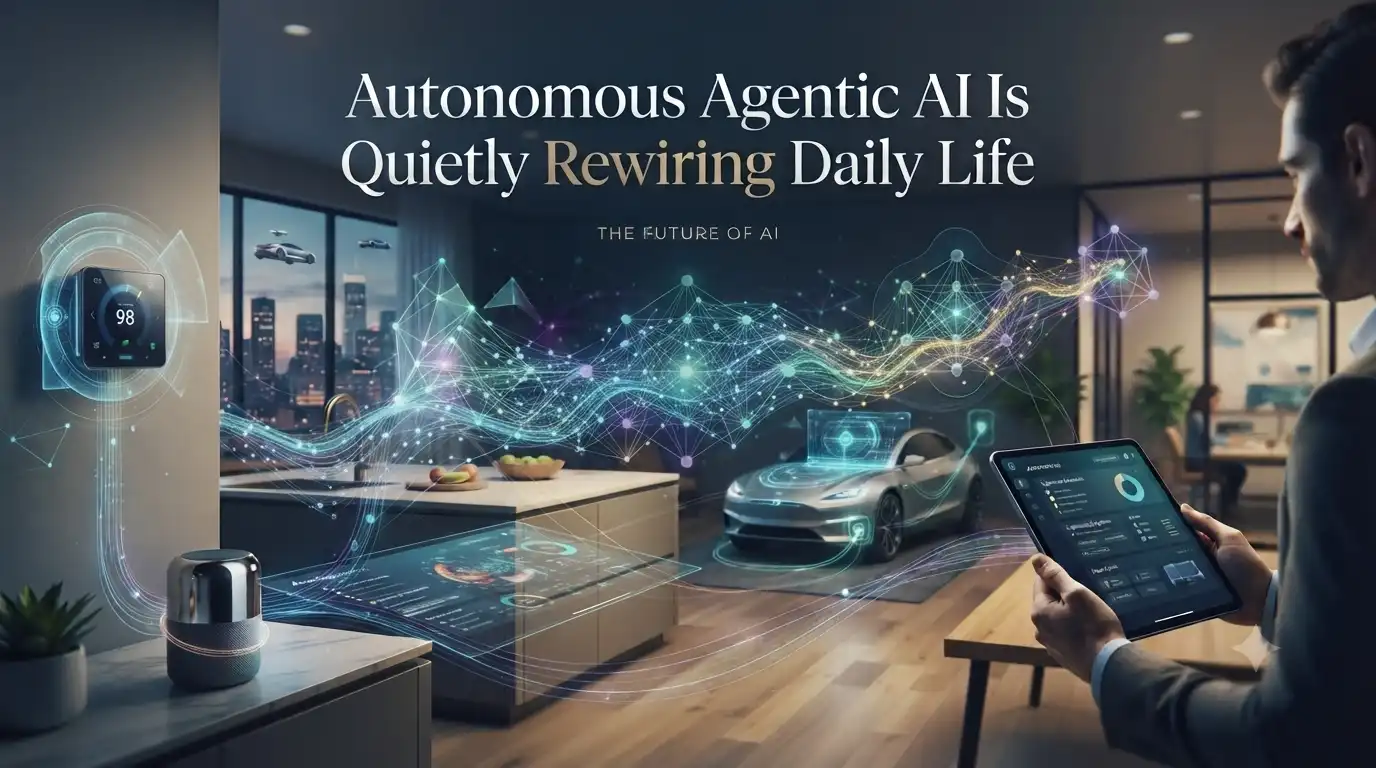
Grab a cup of chai and sit across from me for a second. Think about your average Tuesday evening. Between juggling the family dinner schedule, responding to a flood of work pings, tracking down permission slips, and making sure the grocery delivery actually includes milk, your brain feels a bit like a browser with 84 tabs open—and three of them are playing audio you can’t locate.
We’ve spent the last couple of years talking endlessly about massive data centers, multi-trillion-dollar silicon races, and abstract technological leaps. But while the headlines chase the macro, something far more intimate is happening down in the trenches of everyday existence. Autonomous AI agents are quietly stepping out of our browser tabs and moving straight into our living rooms.
And honestly? It’s about time.
Moving Beyond the glorified Speaker
Let’s be real for a moment. For the past decade, our “smart homes” haven’t been all that smart. Asking a voice assistant to turn on the living room lights or set a 10-minute timer for pasta is convenient, sure. But it hardly qualifies as revolutionary. They are reactive tools. You speak; they obey. If you forget to ask, nothing happens.
What we are looking at now is a completely different beast. Powered by sophisticated agentic architectures, next-gen AI home systems don’t just wait around for instructions—they anticipate, coordinate, and execute complex, multi-step tasks on your behalf.
Imagine your household software operating less like a rigid instruction manual and more like an invisible, hyper-competent chief of staff. We are talking about systems that can:
- Autonomously re-route schedules: When soccer practice gets rained out, the agent automatically texts the carpool parent, rearranges your afternoon calendar, and shifts the slow cooker’s ready-time back by an hour.
- Proactively manage family logistics: Spotting patterns in your grocery consumption and dynamically optimizing orders based on fluctuating local prices and dietary needs.
- Act as a unified communication hub: Sifting through the mountain of chaotic school group chats, extracting the three sentences that actually matter to you, and ignoring the rest.
It’s the shift from static automation to true autonomy. And it fundamentally alters how we experience our homes.
The Pragmatic Reality of Living with an Agent
Of course, introducing a deeply integrated AI agent into the most personal space on earth—your home—brings up a mix of genuine excitement and valid hesitation. We aren’t talking about plugging in a new gadget; we are giving an algorithm the keys to the kingdom of our daily routines.
If you’re anything like me, your first instinct is a healthy dose of skepticism. Do we really want our refrigerators talking to our calendars? Will it feel intrusive?
The trick lies in finding the sweet spot between utility and boundaries. The best implementations of AI in our personal lives don’t feel like Big Brother watching your every move; they feel like a quiet, reliable partner taking the mental load off your shoulders. When an AI agent successfully spots a conflicting dentist appointment, cancels it, reschedules it for next Tuesday, and updates your spouse without you lifting a finger, the skepticism tends to evaporate pretty quickly.
How Families Are Already Adapting
We are seeing early adopters build fascinating workflows that blend human creativity with machine efficiency. Here is a quick snapshot of how households are deploying these new systems:
- Meal Planning & Waste Reduction: Scanning what’s left in the pantry and cross-referencing dietary restrictions to build a zero-waste weekly menu.
- Digital Wellbeing Guardians: Managing screen-time boundaries for kids dynamically, adjusting access based on homework completion and outdoor activity metrics.
- Home Maintenance Coordination: Monitoring smart appliance diagnostics and automatically booking certified local tradespeople before a minor pipe leak turns into a structural catastrophe.
This isn’t about removing the human element from family life. Ironically, by handing off the grueling administrative overhead of modern existence to an AI agent, we are getting something precious back: actual breathing room.
Looking Ahead: The Frictionless Future
We are standing right at the edge of a massive cultural shift. As these autonomous agents become more reliable, contextual, and deeply embedded in our daily devices, the friction of modern life is going to drop significantly.
You won’t have to “learn” how to use your home agent; it will learn how to live with *you*. It will adapt to your moods, understand your shorthand, and respect your quiet hours.
So, as the broader tech world obsesses over the next billion-dollar infrastructure buildout, keep your eyes on the home front. The real revolution won’t be broadcasted from a Silicon Valley stage—it will happen quietly in your kitchen, while your new digital partner handles the heavy lifting so you can finally relax.