Picture this: you’re sitting across from me over coffee, your phone buzzing relentlessly on the table. You’ve got forty-two open browser tabs, three half-composed grocery lists scattered across sticky notes, an unread email thread debating dinner plans, and a calendar that looks like a game of Tetris gone horribly wrong.
Sound familiar? For the past two years, Silicon Valley pitched conversational chatbots as the magic bullet for this exact digital chaos. “Just ask ChatGPT!” they said. But let’s be honest with each other: typing out a five-paragraph prompt just to organize your weekend errands isn’t saving time—it’s just duct-taping a high-tech typewriter onto your existing stress.
That era is ending. We are standing right at the inflection point of the biggest architectural leap since the mobile app boom: the transition from passive text generators to proactive, agentic AI in daily life.
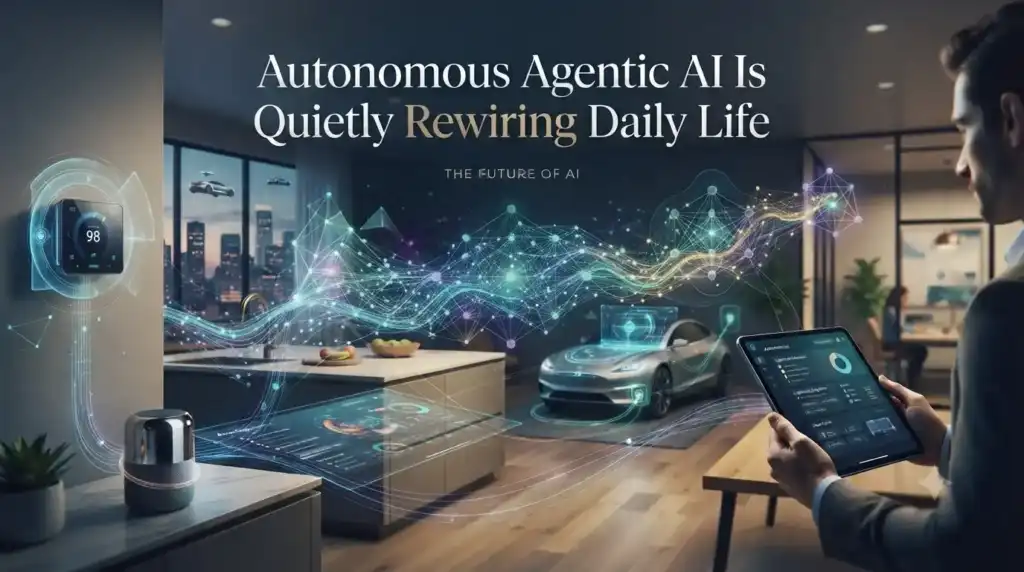
This isn’t about asking an AI to write a haiku about your breakfast. It’s about background software that perceives your routine, formulates multi-step plans, executes tasks across your digital ecosystem, and hands you back the most precious commodity you have: your cognitive bandwidth.
Why Chatbots Were Just the Awkward Teenage Phase
To understand where we’re heading, we need to demystify why traditional generative chatbots feel like a chore. Standard Large Language Models (LLMs) operate on a purely reactive loop: you provide an input token sequence, and the model predicts the statistically optimal output sequence. The moment it spits out the last word, the neural engine goes dormant.
Agentic architecture fundamentally flips the script.
Instead of acting as a glorified autocomplete engine, an autonomous personal agent pairs foundational models with perception modules, short- and long-term memory, and deterministic tool execution. In simple terms: it doesn’t just talk; it acts.
An agent doesn’t wait for your next prompt. It monitors environmental state changes, reasons through bottlenecks, and executes actions across the real world.
When you say, “I need to prep for mom’s birthday next Saturday,” a traditional chatbot gives you a generic checklist. An agentic workflow, however, breaks down that single intent into discrete sub-goals: cross-referencing your calendar, checking your family WhatsApp group for restaurant preferences, querying local reservation APIs, drafting a calendar invite, and queuing up a delivery order for flowers. All before you finish your morning espresso.
The Anatomy of an Everyday Agent: How It Actually Works
How does software pull this off without going completely off the rails? Under the hood, modern agentic systems rely on a four-pillar cycle often called the OODA Loop (Observe, Orient, Decide, Act):
- Perception & State Tracking: The system continuously reads structured data streams—your calendar entries, unread notifications, location triggers, and connected smart-home telemetry.
- Decomposition & Planning: Using techniques like ReAct (Reasoning and Acting) or Tree-of-Thoughts prompting, the model splits complex real-world ambiguity into deterministic, logical steps.
- Function Calling & Tool Use: The agent doesn’t guess how to book a ticket; it translates natural language into structured JSON payloads that ping real-world APIs, from flight aggregators to your banking dashboard.
- Episodic & Semantic Memory: Using local vector databases, the agent remembers personal context over months. It recalls that your partner hates cilantro, your daughter has soccer practice on Thursdays, and you prefer train travel over driving when the distance is under three hours.
It’s this combination of semantic reasoning and deterministic tool usage that gives autonomous agents their real superpower. They aren’t guessing; they are orchestrating.
The Cognitive Science: Offloading the “Invisible Load”
Why does this shift matter so profoundly for our mental health and everyday living? The answer lies in cognitive load theory.
The human prefrontal cortex is extraordinary at creative problem-solving, emotional nuance, and strategic vision. What it is notoriously terrible at is holding dozens of administrative micro-tasks in working memory simultaneously. Psychologists call this the “mental load”—the persistent, low-frequency hum of remembering to refill prescriptions, reschedule dentist visits, and calculate whether you have enough time between meetings to pick up dry cleaning.
When you deploy agentic systems to quietly absorb this administrative friction, something remarkable happens. You aren’t just saving minutes; you are preventing ego depletion. You preserve your mental sharpness for creative work, relationships, and genuine rest, rather than squandering your focus on routine digital plumbing.
The Technical Battleground: Cloud Giant vs. Local Edge AI
Now, let’s address the elephant in the room. Handing over the keys to your personal schedule, communications, and household logistics sounds terrifying if that data is piped straight into a centralized corporate server farm. Nobody wants their private life vacuumed up to train advertising algorithms.
This is where the engineering gets thrilling. The frontier of agentic AI in daily life isn’t happening solely inside massive, water-cooled hyperscale data centers—it is moving directly to your device via Small Language Models (SLMs) and dedicated Neural Processing Units (NPUs).
- On-Device Processing: Ultra-compact models (ranging from 1B to 7B parameters) now run locally on modern silicon. Your sensitive calendar events, text messages, and biometric trends never leave your phone.
- Speculative Decoding & Hybrid Compute: Routine reasoning and tool execution run locally at near-zero latency. The system only reaches out to heavy cloud models when you need intense analytical firepower.
- Deterministic Sandboxing: Modern agents operate within strict programmatic guardrails. Before executing financial transactions or sending external communications, the agent requires a “human-in-the-loop” cryptographic biometric confirmation.
This local-first architecture transforms autonomous software from an invasive surveillance vector into a private digital sovereign asset. It’s an assistant that works entirely for you, on your terms, behind your biometric lockscreen.
What Happens Next? Preparing for the Ambient Shift
We are rapidly moving toward a world where the concept of “opening an app” will feel as outdated as dialing into the internet with a 56k modem. Instead of interacting with dozens of fragmented software silos, you will simply interact with your intent layer. The underlying agents will negotiate with the digital world on your behalf.
So, how do we thrive in this shifting landscape without losing our sense of human agency? Start small:
- Audit Your Daily Friction: Identify the three repetitive administrative loops that drain your energy every single week. That is your prime target for automation.
- Embrace Local-First Tools: Keep an eye on edge-capable AI systems that prioritize zero-retention data policies and on-device NPUs.
- Keep the Wheel on What Matters: Use automation to conquer logistics, but keep your creative decisions, deep relationships, and ethical choices strictly human.
The real promise of artificial intelligence was never about generating generic digital art or writing synthetic essays. It was always about cutting away the mundane clutter of modern civilization so we can spend more time being unapologetically human. The agents are arriving—and life is about to get a whole lot clearer.