
Every time you tap “Pay Now,” log into your bank, or send a private message, you are trusting a single mathematical bet:that multiplying two massive prime numbers is easy, while reversing the process takes a classical supercomputer longer than the age of the universe.
That bet has held up the entire modern internet for nearly fifty years. A sufficiently powerful quantum computer will shatter it in a matter of hours.
Cybersecurity researchers call that tipping point Q-Day—the moment when quantum computers break encryptionstandards like RSA and Elliptic Curve Cryptography (ECC) in the real world. The internet won’t suddenly vanish in a Hollywood-style blackout, yet the quiet collapse of digital trust would hit everything from wire transfers and software updates to state secrets that were stolen years ago.
What Happens on Q-Day?
Public-key encryption collapses: Algorithms like RSA-2048 and ECC which secure HTTPS websites, banking logins, and crypto wallets—become crackable using Shor’s algorithm.
Symmetric encryption mostly survives: AES-256 and SHA-256 only weaken moderately and remain secure with larger key sizes.
The danger already started: Nation-state actors are running “Harvest Now, Decrypt Later” operations today, hoarding encrypted data to unlock once quantum hardware matures.
Why Quantum Math Breaks Today’s Internet (And What Survives)
To understand what actually breaks, you have to separate modern cryptography into two buckets: asymmetric (public-key) encryption and symmetric encryption.
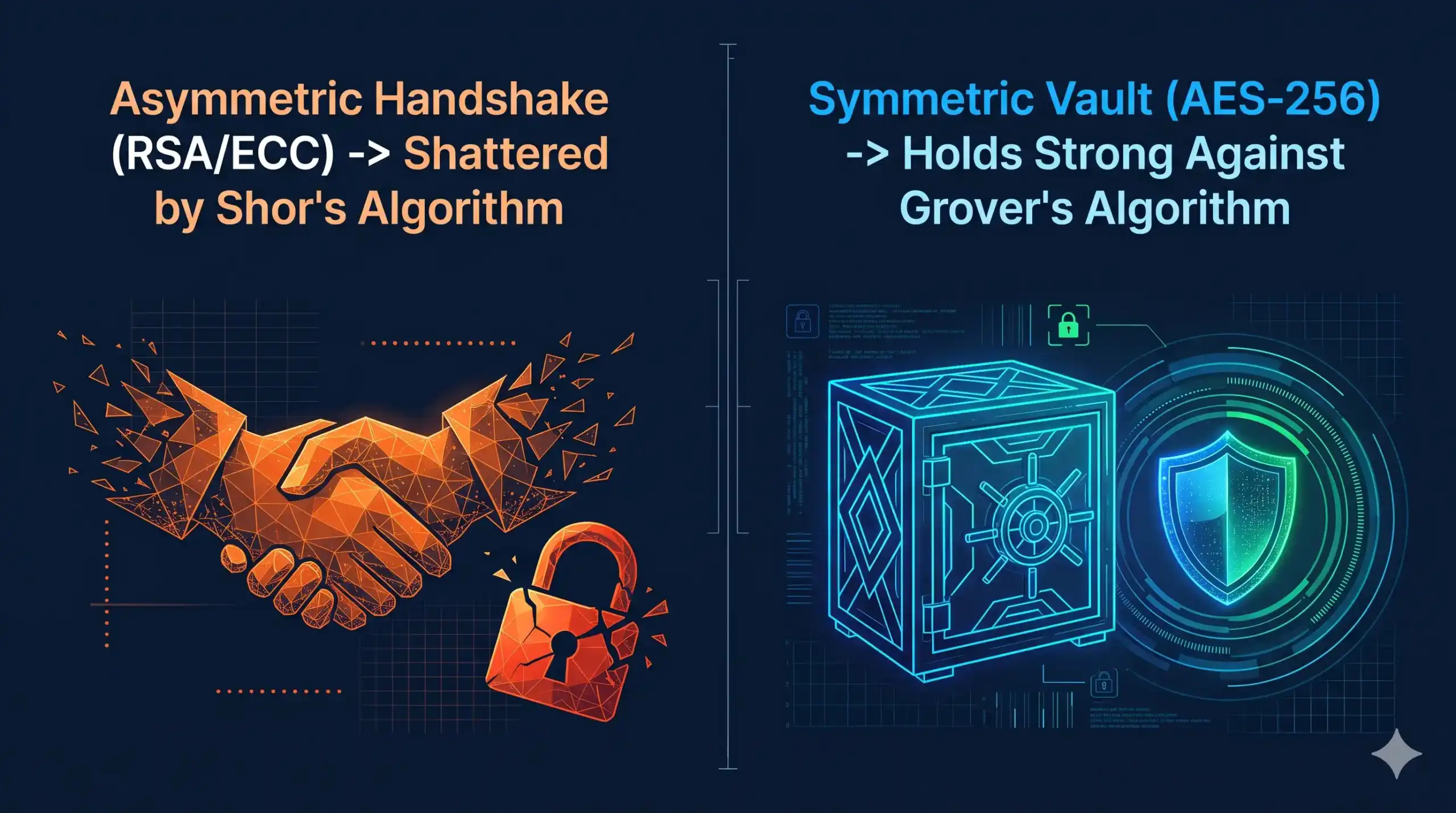
Asymmetric encryption—primarily RSA and Elliptic Curve Cryptography (ECC)—handles digital handshakes and signatures. It lets your browser verify that you are genuinely talking to your bank’s server and lets both sides agree on a shared secret key over an untrusted network.
In 1994, mathematician Peter Shor proved that a fault-tolerant quantum computer running Shor’s algorithm can factor giant numbers and solve discrete logarithms exponentially faster than any classical machine. Once hardware reaches enough error-corrected “logical qubits,” RSA and ECC don’t just get weaker—they become completely transparent.
Symmetric encryption—like AES-256, which scrambles the actual bulk data in your files and traffic—is a different story.Quantum computers can attack it using Grover’s algorithm, which cuts the effective search space in half. That sounds scary until you do the math: cutting a 256-bit key’s security in half still leaves 128 bits of security, which remains practically unbreakable even for a quantum machine.
| Cryptographic System | Where It Is Used Today | Quantum Attack Algorithm | Status After Q-Day |
|---|---|---|---|
| RSA-2048 / RSA-4096 | HTTPS handshakes, VPNs, email signing | Shor’s Algorithm | Completely Broken |
| ECC / ECDSA | TLS certificates, Bitcoin, Ethereum, Signal handshakes | Shor’s Algorithm | Completely Broken |
| AES-128 | Legacy Wi-Fi, older IoT devices | Grover’s Algorithm | Weakened (Upgrade to 256) |
| AES-256 | Cloud storage, disk encryption, HTTPS traffic | Grover’s Algorithm | Safe (Quantum-Resistant) |
| SHA-256 | Password hashing, file integrity, blockchain mining | Grover’s Algorithm | Mostly Safe (Upgrade to SHA-384/512) |

The Threat Already Happening: “Harvest Now, Decrypt Later”
The biggest misconception about Q-Day is assuming we have nothing to worry about until a million-qubit machine sits in a lab. Security teams aren’t just worried about future traffic; they are losing sleep over data crossing the internet right now.
This strategy is known as Harvest Now, Decrypt Later (HNDL). Intelligence agencies and well-funded threat groups intercept and archive massive volumes of encrypted network traffic today—diplomatic cables, defense blueprints,pharmaceutical IP, and long-term financial records.
They can’t read a single byte of it yet. They don’t need to. If a dataset needs to remain confidential for 15 or 20 years, and a cryptographically relevant quantum computer arrives in 10, that data is already compromised the moment it leaves your server.
Real-World Fallout: What Happens When Quantum Computers Break Encryption?
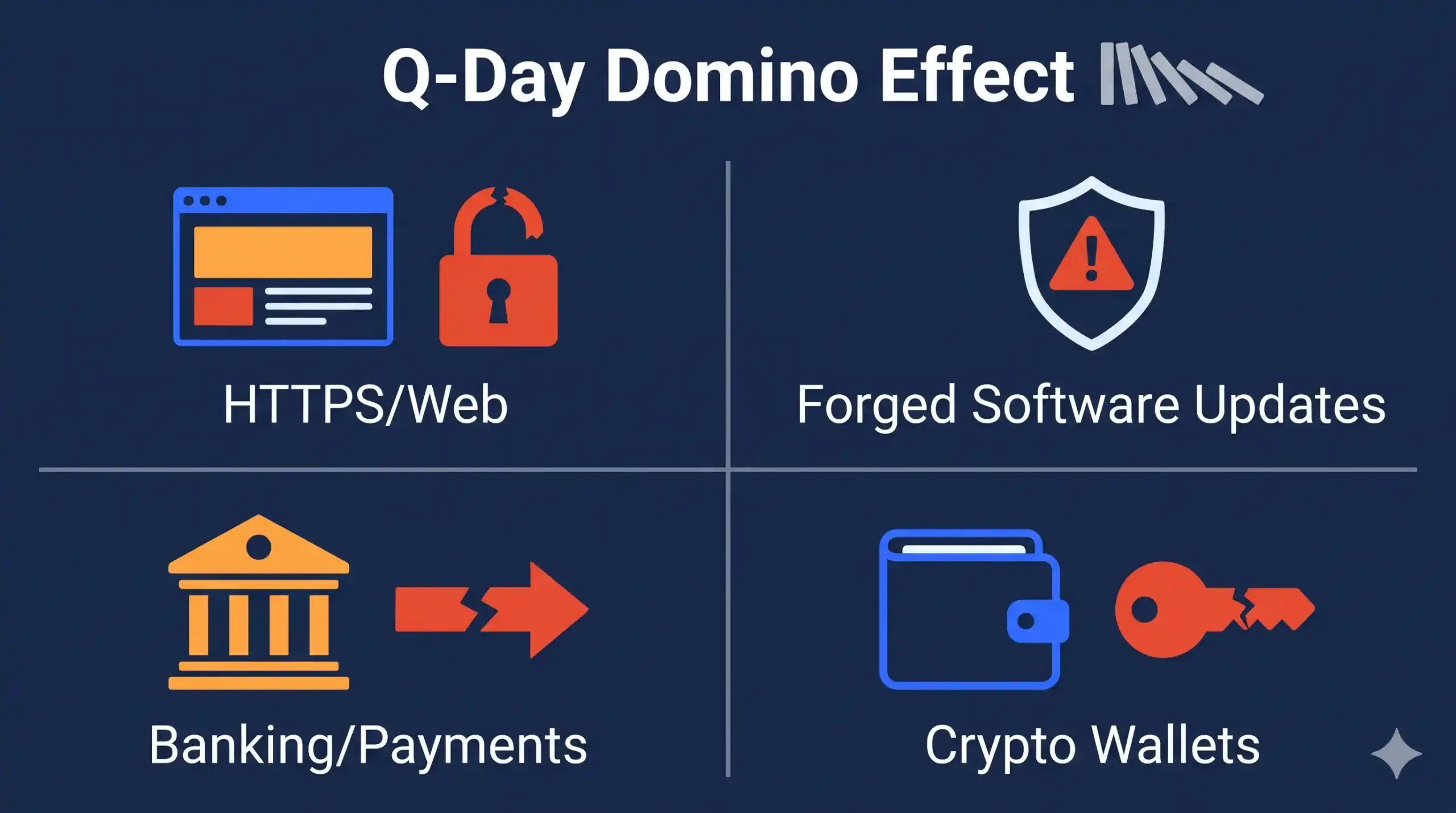
If the world failed to upgrade its cryptography before Q-Day arrived, the damage wouldn’t look like a single dramatic explosion. It would look like the sudden disappearance of proof across four critical pillars of modern life.
1. HTTPS and Web Privacy Evaporate
When you see the padlock in Chrome or Safari, your browser uses RSA or ECC to negotiate a private session key with the website. If an attacker with quantum access intercepts that handshake, they can derive the session key and read your passwords, medical portals, and API tokens in plain text—even if the bulk traffic uses AES-256.
2. Software Updates Become a Weapon
This is the nightmare scenario most people overlook. Operating systems, phones, and cloud servers rely on digital signatures (usually RSA or ECDSA) to verify that an update actually came from Apple, Microsoft, or Linux maintainers.
If an attacker can forge those signatures, they can push malicious firmware straight into power grids, hospital equipment,and millions of laptops—and every device will install it without raising a single alarm.
3. Banking and Financial Infrastructure Stall
Interbank messaging, payment gateways, and hardware security modules (HSMs) depend heavily on public-key certificates to authenticate transactions. Without quantum-safe signatures, banks wouldn’t be able to tell a legitimate ₹10 crore wire transfer from a forged one, forcing institutions to halt automated settlements until systems are patched.
4. Cryptocurrencies Face an Existential Crisis
Blockchains like Bitcoin and Ethereum use ECDSA to link your public wallet address to your private key. Under normal circumstances, sharing your public key is safe because nobody can reverse-engineer your private key from it.
On Q-Day, any wallet whose public key has ever been exposed on-chain—including millions of dormant coins in early “Satoshi-era” addresses—could be drained in seconds. Even active transactions sitting in the mempool waiting for confirmation could be hijacked mid-flight before a block is mined.
How Engineers Are Fighting Back: Post-Quantum Cryptography (PQC)
Here is the good news: we don’t need quantum computers to defend against quantum computers.
Cryptographers have spent the last decade building Post-Quantum Cryptography (PQC)—brand-new mathematical problems that run on normal laptops and smartphones, yet remain brutally hard for both classical and quantum processors to crack. Instead of factoring prime numbers, these algorithms rely on structures like high-dimensional mathematical lattices and hash-based signatures.
In August 2024, the U.S. National Institute of Standards and Technology (NIST) finalized its first three official post-quantum standards:
-
ML-KEM (FIPS 203, formerly CRYSTALS-Kyber): The primary replacement for general encryption and web key exchange.
-
ML-DSA (FIPS 204, formerly CRYSTALS-Dilithium): The primary replacement for digital signatures.
-
SLH-DSA (FIPS 205, formerly SPHINCS+): A stateless hash-based backup signature standard in case a flaw is ever found in lattice math.
Major tech infrastructure isn’t waiting around. Chrome, Cloudflare, Apple iMessage (via its PQ3 protocol), and Signal (via PQXDH) have already rolled out hybrid encryption—wrapping connections in both classical ECC and post-quantum ML-KEM simultaneously so your traffic stays safe even if one algorithm fails.
The Hardest Part Isn’t the Math—It’s the Migration
If the math is already solved, why are security engineers still stressed? Because swapping out the foundation of the internet while it’s running at full speed is a logistical monster.
Post-quantum keys and signatures are significantly larger than ECC keys, which can break older network appliances,choke embedded IoT devices, and slow down TLS handshakes if poorly configured. Worse, most enterprises don’t even have a complete inventory of where RSA is hardcoded across their legacy databases, APIs, and third-party vendors.
If you manage software or IT infrastructure, here is the practical 4-step playbook to prepare right now:
-
Build a Cryptographic Inventory: Scan your repositories, TLS certificates, VPNs, and APIs to map every instance of RSA and ECC.
-
Prioritize Long-Shelf-Life Data: Identify records that must stay private for 10+ years (health data, financials, IP) and move those connections to hybrid PQC first.
-
Invest in Crypto-Agility: Decouple encryption logic from your core application code so you can swap algorithms via configuration rather than painful rewrites.
-
Audit Your Vendors: Ask your cloud provider, payment gateway, and SaaS vendors for their concrete NIST PQC migration roadmap.
Frequently Asked Questions (People Also Ask)
When will quantum computers actually be able to break RSA-2048?
Nobody knows the exact date, because building millions of stable physical qubits to create a few thousand error-corrected logical qubits is an immense engineering hurdle. Most cybersecurity agencies and researchers place the realistic risk window sometime between the early 2030s and 2040 [INSERT VERIFIED STAT/SOURCE], which is why governments are mandating migrations now.
Will quantum computers destroy Bitcoin and other cryptocurrencies?
Not automatically, provided the networks upgrade in time. Bitcoin and Ethereum developers can introduce post-quantum signature schemes via protocol upgrades, though individual users will eventually need to migrate their funds to quantum-resistant wallet addresses before Q-Day arrives.
Do I need to change my passwords because of quantum computing?
No—quantum computers don’t magically guess random passwords, and password hashing algorithms paired with AES-256 remain resilient. Your best personal defense is still using a password manager, enabling phishing-resistant MFA, and keeping your browsers and messaging apps updated so you automatically receive hybrid PQC protections.
Does post-quantum encryption require buying a quantum computer?
Not at all. Post-quantum cryptography (PQC) is purely software-based math designed to run on the exact classical CPUs,servers, and smartphones you already own—it is simply engineered to resist attacks from a quantum computer.
The Bottom Line: A Race Against the Clock, Not the Apocalypse
Understanding what happens when quantum computers break encryption makes one thing clear: Q-Day isn’t a sudden sci-fi apocalypse, it’s a deadline. The mathematical defenses already exist, and the biggest platforms on the web are quietly deploying them behind the scenes.
The real winners and losers will come down to execution. Organizations that treat crypto-agility as an engineering priority today will sail past Q-Day without a scratch; those that wait until the first RSA key falls will be patching a sinking ship in the dark.
Is your engineering team already tracking NIST’s PQC standards, or is quantum security still sitting in the “deal with it later” backlog? Drop your take in the comments—and if you want to check whether your own browser is already using hybrid post-quantum TLS, run a quick test on Cloudflare’s PQC check page today.